
Key Highlights
- Any red and white patches in mouth that do not disappear within a period of two weeks should be evaluated by the professionals.
- This is because such patches may develop due to infection, irritation, inflammation, dysplasia, or mouth cancer.
- Painless patches do not necessarily equate to safe patches, as there are some patches that do not hurt.
- Clinical tests and biopsies can be carried out to investigate the causes of patches.
- In order to avoid having such patches and detect them in their early stages, you should avoid smoking and drinking alcohol excessively and have a good oral hygiene.
Are you experiencing any weird red or white patches in your mouth? Although these red and white patches in mouth may arise due to mild irritation, infection, and ulcers, having these patches for a long time may be an indication of pre-cancer or even oral cancer.
Ignoring these signs may cause delay in seeking treatment and diagnosis. Knowing about these signs will assist you in determining when it’s time for you to see a doctor.
Do you have patches in your mouth that have existed for more than two weeks? Find out about these patches.
What Do Red and White Patches in the Mouth Mean?
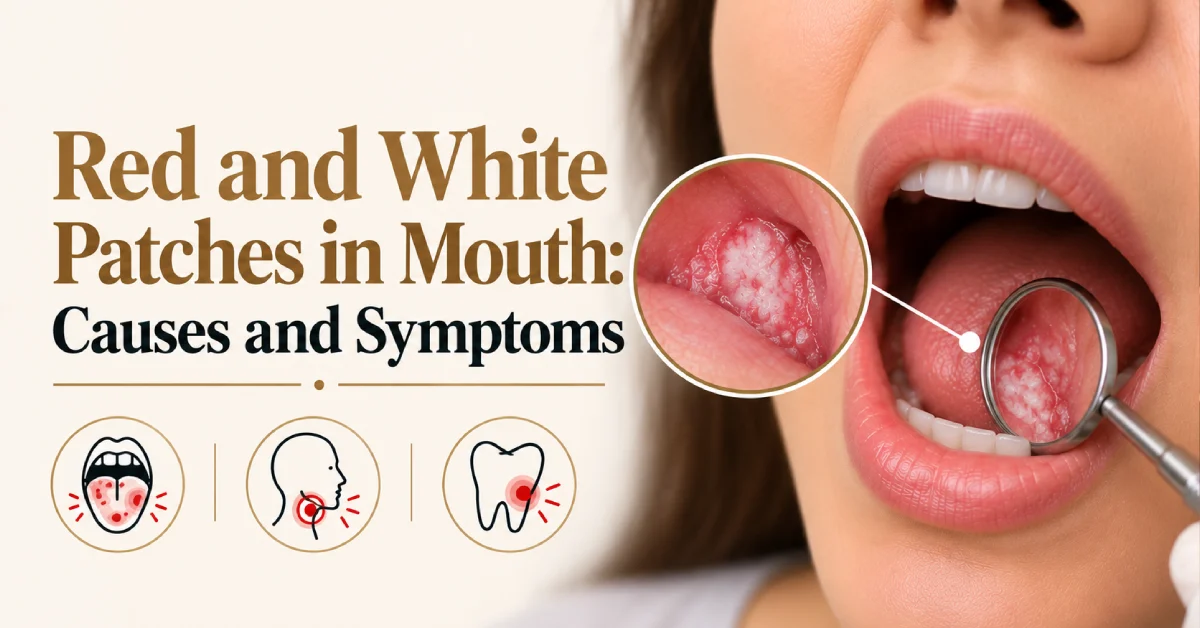
Red or white patches on tongue represent changes in the oral lining that may arise from irritation, infection, inflammation, or abnormal cell development. Their appearance alone cannot confirm cancer.
The patches may occur on:
- The tongue and gums
- The inner cheeks and lips
- The roof, floor, or other areas of the mouth
Some disappear after the underlying cause is treated. Others persist and need further investigation.
What Are the Main Types of Oral Patches?
- Leukoplakia
These white plaques are usually not able to be rubbed off. Exposure to tobacco is linked to the occurrence of leukoplakia. They pose a threat of developing into cancer.
- Erythroplakia
These patches are sometimes velvety in texture. They may be linked with the development of cancer.
- Mixed lesions
When there are both red and white areas, then this is referred to as erythroleukoplakia. This requires immediate treatment since the abnormalities are present.
What Causes Red or White Patches Inside the Mouth?
Various causes may result in red or white patches inside mouth. Some of the conditions may be temporary whereas others may need professional diagnosis. The proper examination will help in making this distinction and taking care of the issue.
Common causes include:
- Oral candidiasis
This infection will produce creamy areas that may be wiped away to expose the irritated mucosa underneath.
- Oral Lichen Planus
This condition is known to produce thin white lines, red areas, or ulceration.
- Injuries due to chronic irritation
This includes sharp teeth, ill-fitted dentures, and constant biting of the cheeks.
- Alcohol and smoking
This includes smoking, chewing tobacco, gutka, paan and excessive alcohol consumption.
- Nutritional deficiencies
Low levels of certain nutrients, including iron and vitamin B12, may contribute to oral changes.
Where Can These Patches Appear?
The site can give us clues, but cannot diagnose the condition.
- White patches on tongue – This could be because of an indication of fungus, irritation, or leukoplakia.
- Red patches on the tongue – Red patches on tongue may be caused by swelling, injury, and occasionally by concerning changes in the tissue.
- White patches in the mouth – These include the inner lining of the mouth, gums, and palate.
- Red patches in the mouth – The red patches are seen in the gums, inner cheek, and floor of the mouth.
What Symptoms Can Accompany Oral Patches?
Oral patches may not cause any pain at first, but sores that do not heal, bleeding, swelling, and other changes should be checked.
The following signs should be considered:
- Persistent sores or irritation
- Problems in chewing, swallowing, and moving the jaw
- Lumps, bleeding, numbness
- Loose teeth, voice changes, persistent throat or ear pain
There can be multiple reasons for these symptoms.
How Can You Tell a Mouth Ulcer from Cancer?
Ordinary ulcers often improve within one or two weeks, whereas suspicious lesions may persist, enlarge, bleed, or develop firm edges. Appearance and duration alone cannot provide a definitive diagnosis.
| Feature | Typical mouth ulcer | Potentially suspicious lesion |
| Healing | Often improves within two weeks | May persist or worsen |
| Appearance | Usually a shallow sore | May appear red, white, thickened, or irregular |
| Pain | Often tender | May be painless or painful |
| Assessment | Needed if persistent or recurrent | Prompt professional examination recommended |
A comparison between mouth ulcer vs cancer can be quite confusing. The physician can do an inspection of the affected area and advise on a biopsy in case of doubt. Do not make your diagnosis solely on pictures and pain.
What Are the Risk Factors for Oral Cancer?
The use of tobacco products, excessive drinking, certain types of infection from the human papillomavirus, and UV radiation of the lips may also increase one’s risk of developing oral cancer.
Lower your risk of getting the disease by doing the following:
- Avoiding the use of tobacco products and minimizing consumption of alcohol.
- Using lip sunscreen.
- Maintaining good oral hygiene and eating healthily.
- Visiting the dentist regularly.
See a professional for any persistent lesions.
Which Signs of Mouth Cancer Need Immediate Attention
The following are some signs of mouth cancer, such as ulcers, lumps, reddish/white patches, bleeding, numbness, and swallowing problems. If you have patches that do not heal for two weeks, swell and bleed, then you need to see your dentist.
How Are Suspicious Oral Patches Diagnosed
The lesion is evaluated based on the symptoms, duration of the condition, history, and risk factors by a dentist or specialist.
The assessment process may include the following:
- Oral examination – The mouth, tongue, and neck.
- Biopsy – Examination of the tissue using a microscope.
- Imaging – CT, MRI, or PET scans if necessary.
- Blood test – The underlying disease if suspected.
The oral cancer screening process identifies suspicious lesions. However, the biopsy will be required for a final diagnosis.
How Are Red and White Patches Treated?
A professional assessment will help identify proper treatment to administer in case of oral lesions.
- Infections – Some medicines may be prescribed.
- Irritations – Management of sharp teeth, dentures and injuries will suffice.
- Precancerous Lesions – They could either be followed-up or surgically excised.
- Oral Cancer – It could be managed using surgery, radiotherapy, chemotherapy or drugs.
Patients should be checked regularly to follow up on these persistent lesions.
Bottom Line
Persistent changes in the mouth should not be overlooked even though they are not painful. There are different causes like infections and irritations which can result into white and red patches inside mouth but when the lesion persists for more than 2 weeks, grows in size, bleeds or recurs then it should be checked out.
Early identification will help identify the cause of the problem and the need for treatment or further investigation. Dr. Mukul N. Padhye, a trusted oral and maxillofacial surgeon in Mumbai, has over 30 years of surgical experience.
Schedule an appointment with Dr. Mukul N. Padhye today.